

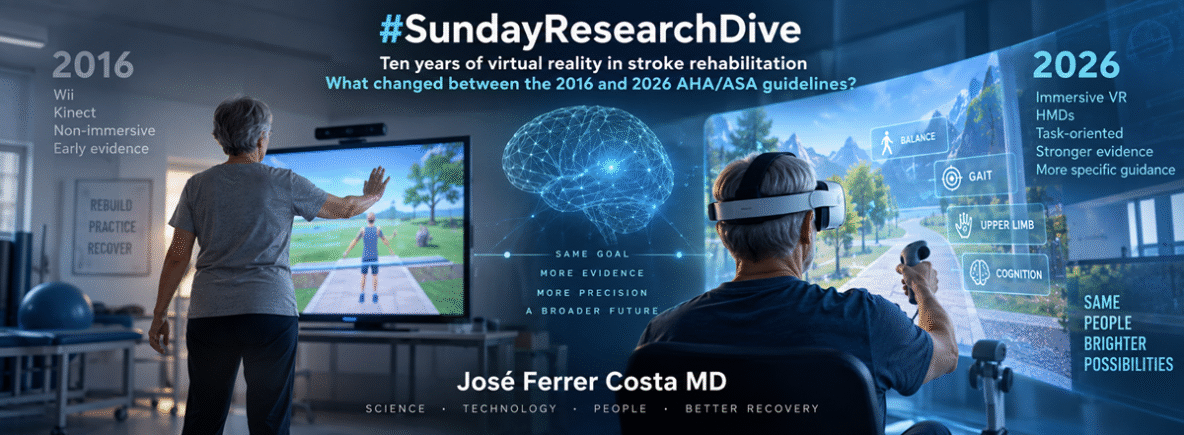
A decade after its previous comprehensive guideline on adult stroke rehabilitation, the American Heart Association and American Stroke Association have published a full update.
Virtual reality was already present in the 2016 guideline. The interesting question, therefore, is not whether VR has finally entered stroke rehabilitation guidance.
It is how its role has changed after ten additional years of technological development and clinical research.
The 2016 guideline reviewed evidence available through 2014 and already included VR in several rehabilitation domains. The 2026 guideline replaces that document and incorporates evidence accumulated since then, with its literature search conducted between June and October 2025.
What changed?
| Rehabilitation domain | 2016 AHA/ASA | 2026 AHA/ASA | Evolution |
| Balance | No specific VR recommendation | 2a, B-NR. VR-based balance training, including gaming-based interventions, can be useful | New explicit recommendation |
| Gait and mobility | IIb, B. VR may be beneficial for improving gait | 2a, B-R. Interactive gait training with exergames or VR can improve walking speed, endurance, mobility, balance and gait parameters | Clear strengthening |
| Upper limb | IIa, B. VR reasonable for delivering upper-extremity movement practice | 2a, B-R. VR reasonable for providing additional practice to improve motor skills | Similar recommendation class, with updated randomized evidence |
| Visual-spatial / perceptual deficits | IIb, B. VR environments may be considered | 2b, B-NR. VR therapy may be considered | Broadly stable |
| Cognition | IIb, C. VR training may be considered, but efficacy was not well established | 1, B-R for supervised, adaptive technology-supported cognitive training, with VR among the supporting approaches | Major maturation of the broader technology-supported category, not a Class 1 recommendation for VR alone |
| Spatial neglect | IIa, A, with VR included among several possible approaches | 2b, B-NR. Limb activation or VR may be reasonable | More cautious in 2026 |
Note: The AHA/ASA evidence framework was updated between the two guidelines. The 2016 Level B category was later divided into B-R (randomized) and B-NR (nonrandomized), while Level C was subdivided into C-LD and C-EO. Therefore, changes in the lettered level should be interpreted alongside the recommendation wording and class, not as a simple one-to-one upgrade.
The change in gait is particularly clear. In 2016, the recommendation stated that VR “may be beneficial” for improving gait, with a Class IIb, Level B classification.
In 2026, interactive gait training using exergames or VR receives a Class 2a, Level B-R recommendation, with specific outcomes including walking speed, endurance, mobility, balance and spatiotemporal gait parameters.
Balance also receives its own explicit VR recommendation for the first time, Class 2a, Level B-NR.
The evolution is not uniformly upward. Visual-perceptual rehabilitation remains cautiously supported, while the recommendation involving VR for spatial neglect is more conservative in 2026.
That matters. Ten years of additional research have not simply made every indication stronger. They have helped distinguish areas where the evidence appears more convincing from those where uncertainty remains.
Are we really comparing the same “VR”?
Not entirely.
This is probably the main caveat when comparing the two guidelines.
In 2016, much of the literature classified as virtual reality involved screen-based environments, commercial gaming platforms and motion-controlled systems such as the Nintendo Wii and Xbox Kinect. The guideline itself noted substantial variation in technologies and training programmes, limiting generalisability.
The technological landscape has changed considerably since then.
Contemporary rehabilitation research increasingly includes immersive head-mounted displays, standalone systems, improved tracking and more interactive, task-oriented virtual environments. The 2026 evidence base still includes non-immersive and gaming-based approaches, but it also incorporates studies using immersive VR and HMD-based cognitive rehabilitation.
A change from IIb to 2a, therefore, cannot always be interpreted as the same intervention simply receiving stronger evidence.
In some cases, both the evidence and the intervention itself have changed.
We have also become better at describing what we are actually doing
The methodological evolution may be just as important as the technological one.
Older VR studies were often difficult to compare because essential elements of the intervention were incompletely reported. Hardware, software, level of immersion, interaction, dose, supervision and even the content delivered within VR were not always described in enough detail.
The recently published INVIRTUE guideline illustrates the scale of this problem. Its authors cite evidence showing that only 23% of reviewed studies provided a substantial description of VR content and only 46% adequately described the hardware. Poor reporting makes interpretation, replication and evidence synthesis considerably more difficult.
The field is now developing more specific reporting standards.
RATE-XR provides guidance for reporting early-phase clinical evaluations of XR applications.
INVIRTUE, focused specifically on therapeutic immersive VR delivered through head-mounted displays, complements this by defining 16 intervention-reporting items across six domains: theory, content, deployment, development, safety and context.
These reporting frameworks are too recent to explain the evidence accumulated across the whole decade, but they reflect a broader methodological maturation of the field.
Researchers are encouraged to describe the clinical aim, proposed mechanism, application content, interactivity and feedback, tailoring, hardware, dosage, supervision, professional training, safety considerations and co-interventions.
INVIRTUE explicitly positions itself alongside RATE-XR rather than as a replacement. RATE-XR addresses the reporting of XR evaluation studies more broadly, whereas INVIRTUE focuses in greater depth on describing the VR intervention itself.
This matters because evidence synthesis is only as meaningful as the interventions being compared.
A Wii-based balance game and an immersive HMD application with six-degree-of-freedom tracking, interactive tasks and adaptive progression may both be labelled “VR”, but they are not necessarily equivalent rehabilitation interventions.
What does the 2026 guideline really tell us?
Perhaps the most interesting change is not simply that some recommendation classes are stronger.
Over the last decade, the field has gradually moved away from the broad question:
- “Does virtual reality work after stroke?”
toward more clinically useful questions:
- For which rehabilitation target?
- For which patient?
- At which stage of recovery?
- Using what type of VR?
- At what dose?
- With how much interaction and feedback?
- Under what level of supervision?
- And as an alternative to, or an additional way of delivering, established rehabilitation practice?
The 2026 guideline reflects some of this maturation.
For upper-limb rehabilitation, for example, VR is recommended as a way of providing additional practice, not because it has consistently demonstrated superiority over other active rehabilitation approaches.
That distinction is important.
The value of VR may increasingly lie not in being a separate treatment category, but in how it enables rehabilitation practice by increasing repetition, providing feedback, supporting task engagement or creating environments that would otherwise be difficult to reproduce.
My take
The comparison between 2016 and 2026 should therefore be interpreted carefully.
It is not simply a story of evidence grades moving upwards.
It reflects three parallel developments: more capable and diverse technology, a larger and more differentiated evidence base and a more mature approach to describing and evaluating XR interventions.
We are still far from knowing the optimal configuration for every rehabilitation indication. Dose, timing, patient selection and technological heterogeneity remain important research gaps.
But perhaps the most meaningful change over these ten years is this:
In 2016, the field was still establishing where VR might fit within stroke rehabilitation. In 2026, we are beginning to define that role more precisely.
That feels like progress.
📖 Richards LG, Ifejika NL, Stein J, et al. 2026 Guideline for Adult Stroke Rehabilitation and Recovery: A Guideline From the American Heart Association/American Stroke Association. Stroke. 2026. doi:10.1161/STR.0000000000000536. https://pubmed.ncbi.nlm.nih.gov/42657476/
📖 Winstein CJ, Stein J, Arena R, et al. Guidelines for Adult Stroke Rehabilitation and Recovery. Stroke. 2016;47:e98-e169. doi:10.1161/STR.0000000000000098. https://pubmed.ncbi.nlm.nih.gov/27145936/
📖 Slatman S, Harvie D, van der Heijden M, et al. Reporting Guideline for Therapeutic Immersive Virtual Reality Interventions: International eDelphi Study (INVIRTUE). Journal of Medical Extended Reality. 2025;2:345-361. doi:10.1177/29941520251404744. https://pmc.ncbi.nlm.nih.gov/articles/PMC13115730/
#VirtualReality #StrokeRehabilitation #Neurorehabilitation #ExtendedReality #DigitalHealth #XRResearch
